

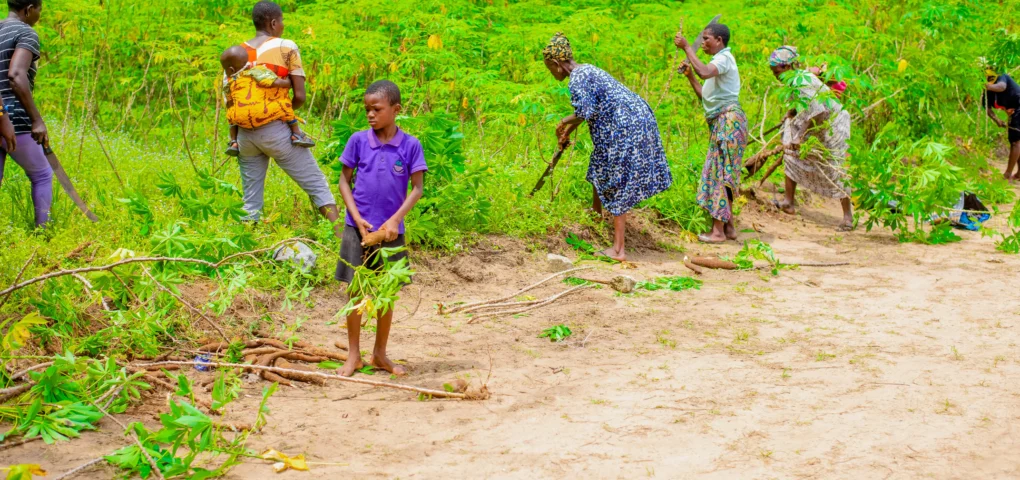
Kokori did not need a miracle. It needed cassava stems, a patch of tilled soil, and someone willing to believe that a farmer given the right start would not waste it.
So that’s what happened. Early one morning, under a sky still deciding whether to rain, a line of women gathered where the road gives way to bush, some with babies strapped to their backs, some leaning bicycles against the nearest tree, all of them waiting for something most of Nigeria takes for granted: a fair shot.
What they walked away with looked unglamorous — just stems, sticks to anyone who didn’t know better. But the women of Kokori knew what they were holding: not aid, but a start. A start, handled right, grows.
The Math a Mother Does in Silence
Nobody teaches you this kind of arithmetic, and nobody talks about it out loud. It happens quietly, behind a woman’s eyes, while she’s stirring a pot or walking to market: If the harvest fails, what do we eat in March? If I sell early, will the money stretch to July? It’s a private, relentless calculation, the kind that ages a person faster than the years actually do.
In Kokori, that math has been running in the background of daily life for as long as anyone can remember. Farming close to the edge isn’t a metaphor there; it’s Tuesday. A bad rainy season isn’t an inconvenience, it is the difference between a full pot and an empty one.
Empowering female farmers in Kokori didn’t erase that math overnight. But it changed one crucial variable: for the first time, the numbers had a little room to breathe.
Cassava Doesn’t Ask for Much — That’s the Point
Thus, the Foundation chose cassava instead of something more delicate, more demanding, or likely to fail in unforgiving soil. Cassava survives. It shrugs off a poor rainy season.
It grows in land other crops would abandon. Consequently, handing a woman cassava stems isn’t a gamble; it’s something closer to a guarantee.
Then, watch what happens next, and it starts to look less like a donation and more like a chain reaction. A stem becomes a plant. A plant becomes a harvest. A harvest becomes food on a table that used to run thin by the dry season and, if the yield is generous, a little extra to sell at market, cash that didn’t exist in the household budget before.
Multiply that by every woman who took stems home that morning, and Kokori isn’t looking at one successful season. It’s looking at a pattern that repeats, on its own, without anyone having to ask twice.
That’s the quiet brilliance of empowering female farmers in Kokori: it isn’t a gift that gets used up. It’s a gift that gets replanted.
What Nobody Photographs
The handover made for good photos werre women in bright ankara, cassava stems bundled and ready, palm trees leaning into frame like they were in on the moment too.
But the part of this story that matters most happened weeks later, far from any camera: a woman kneeling in her own small plot at dawn, pressing a stem into soil she’d worked with her own hands, trusting that something good was coming even though she couldn’t see it yet.
That’s faith with dirt under its fingernails. And it’s the real engine behind everything the White Lioness Pride Foundation set in motion that morning not the ceremony, but the months of unglamorous, unphotographed work that followed it.
Conclusively
Here’s the thing about planting something in Kokori’s soil: it doesn’t stay contained to one farmer, one field, one season. A woman with a surplus shares cuttings with her neighbor, and a good harvest becomes proof, proof that spreads faster than charity ever could.
If this story moved you, know that the Foundation’s work in Kokori is far from finished, and it grows through people willing to [support the next planting season.